The Alpine INE-W940 has the essentials you need through its 6.1-inch WVGA touch-screen monitor: Bluetooth wireless technology and 3D Navigation. Plus you get Pandora and SiriusXM compatibility. All this amazing technology at your fingertips and it comes in the easiest to use AVN unit on the market. The INE-W940 also features Visual Enhancement, a new technology that provides a more balanced picture, not over-emphasizing dark or light areas, so movies are seen with greater clarity. All of the graphics are crisp and clean for your viewing pleasure.
Overview
- 6.1-inch WVGA High Resolution Touch Control Display
- 50 Watts x 4
- 3 2-Volt Pre-amp Outputs
- DVD, AAC, MP3, DivX Playback
- Built-in Navigation with 3D & 2D mapping
- Bluetooth® Hands-Free Calling & Audio Streaming
- Android™, Blackberry®, and iPhone Pandora Control
- Works with iPod® and iPhone®
- SiriusXM SXV200 Tuner Ready
The More Maps, the Merrier

The INE-W940 offers reliable navigation with preloaded NAVTEQ® map data of the United States and Canada, including Alaska, Hawaii, Puerto Rico and the Virgin Islands, which translates to maps galore. Choose from different intuitive map view options, such as 3D mapping, split map, and turn-by-turn arrow view. This unit also features Alpine's exclusive Graphical User Interface with intuitive screen graphics, so it's easy for you to find your way. Get quick and easy directions from start to finish.
Close Encounters with 3D Maps
The INE-W940 uses an enhanced navigation platform, which includes 3D view. Major landmarks, buildings and terrain details in main metropolitan areas are depicted in 3D, for easier recognition while driving. Freeway exit routes and exit signs are presented in vivid three-dimensional detail, to give you a realistic view of where to go. Other navigation features include a highway services list which shows the services at each exit (Gas, Food, ATMs, etc.); Auto Zoom, which delivers proximity zooming as you approach the next driving maneuver; and the freeform search function, which lets you type in the first letters of the destination using the formal name (ex: Alpine) or a category type (ex: Electronics Company).
Advanced Accuracy with OnPoint™ Plus
The INE-W940 uses Alpine's OnPoint Plus Advanced GPS Positioning. This ensures that your vehicle stays accurately positioned on the map even in areas where it's difficult to receive GPS reception, such as in a tunnel or around tall buildings. OnPoint Plus simultaneously uses three technologies - satellite-linked positioning data, gyro sensor technology (to determine the vehicle's direction) and accelerometer technology (to gauge the vehicle's speed) - resulting in continuous coverage of the location of your vehicle. As an additional Plus for accuracy, an optional connection for speed pulse connectivity to the vehicle is available. With the use of these packaged technologies OnPoint Plus ensures you’re spot-on while en route.
Let Alpine Lead the Way
With turn-by-turn instructions delivered by Text-to-Speech (TTS) technology, street names, freeway numbers and freeway exit names are announced clearly through your vehicle’s audio system. Directions are available in English, Spanish, or French. With a unique database of 6 million POI's (Points of Interest), you can choose from a plethora of places to go, whether you're hungry and looking for a place to eat, or need to fill up at the nearest gas station! Assistive mapping visuals display essential driving information such as One-Way Street icons and Highway Junction View for maneuvering complex interchanges. These extra navigation features help guide you right to your destination!
Works with Pandora Internet Radio for iPhone, Android™, and BlackBerry®

Stream music from your Android or Blackberry smartphone using Alpine’s Advanced technology. Enjoy easy, wireless operation of your favorite Pandora channels with Thumbs Up/Thumbs Down buttons directly on the faceplate, QuickSearch features, and even create new Pandora stations and bookmark your favorite tunes on the go. Alpine’s Media XPander PRO DSP-Sound Expansion circuitry ensures the best possible sound for streaming music from your Pandora connection. Enjoy the same great Pandora features from your iPhone by connecting the optional KCE-461iV iPod/iPhone audio/video cable.
Note: Third party services may not be available in all areas; please contact an authorized retailer for coverage in your area.
Bluetooth Hands-Free Calling & Audio Streaming

Don’t fuss or fiddle with your phone and say goodbye to uncomfortable headsets and earpieces. Most importantly, stay focused on safe driving. Many state laws require you to use a hands-free device if you are driving behind the wheel, and with good reason. The perfect way to stay safe and still carry conversations in the car is with the use of a hands-free device. Get the convenience of both with the INE-W940! This unit is equipped with Bluetoothwireless technology so there is no need for any additional adapters.
Microphone Included

This unit comes with all that’s needed for
Bluetooth convenience. The INE-W940 comes with a tuned microphone that’s engineered to reduce noise interference and feedback. This allows optimal placement in your car, for the best possible sound quality.
Audio Streaming, even with iPhone’s iOS 6
Do you have a large music library on your phone? The INE-W940 can stream and control your phone's music via Bluetooth A2DP and AVRCP profiles. Not only can it control and stream your music through Bluetooth, it can process your music using its built-in Media XPander PRO DSP Sound Expansion to ensure you get the best sound you deserve. Want to listen to your iPhone without plugging-in? Stream your iTunes music library via Bluetooth. Whether you have music on your iPhone locally or on iTunes Match, the INE-W940 can stream your tunes!
iTunes Tagging—Get New Songs on the Go
The INE-W940 is enabled for iTunes Tagging and when you hear a song you like, simply press the on-screen [Tag] button that appears below the song information. This iTunes Tagging feature lets you Tag songs you hear on Satellite Radio or analog radio stations and stores the info on your iOS device. The next time you connect your iPod to iTunes, you will be able to preview your selections and then purchase and download them from directly from iTunes.
Made for iPod / Works with iPhone (optional KCU-461iV cable required)

It’s convenient to control your iPod or iPhone in the car – enjoy seamless operation of your iPod in addition to full control of all your favorite media sources. Control all search options of your iPod directly from the INE-W940, via Playlist, Artist, Album, Song, Genre, Podcast, or Composer. The USB connection allows for high-quality iPod playback and delivers an even faster access speed so you’ll find songs as quickly as you expect to find them on your iPod.
Get access to and control of all the songs from your iPhone right from the head unit! Large music libraries are no problem with a faster connection speed and QuickSearch featuring Alphabet Search, you can easily scroll through long lists of music by skipping through the letters of the alphabet. Once you find the letter you want, you can jump to the exact song!
Note: MP3 device or cell phone can only be independently controlled through the head unit when using the USB connection, not with the AUX connection.
Visit the
Apple site to identify your model iPod.
iPod Video Control
You can also easily view and control your iPod movies from the INE-W940 screen.*
*iPhones with Lightning connector not supported.
Satellite Radio Ready

Add the SiriusXM tuner (model number SXV200) and you have everything you need to upgrade your sound experience and expand your entertainment choices. The new SXV200 gives access to an expanded channel lineup of new and exclusive commercial-free music, sports and comedy that includes SiriusXM Latino, a new suite of Spanish-language programming. The INE-W940 allow users to control SiriusXM features including iTunes® Tagging; SiriusXM Replay™ for pause, rewind and replay of up to 30 minutes of live SiriusXM content; Song Alert and Artist Alert for notification when a favorite song or artist is playing on any channel; and Game Alert™ for notification when favorite teams from the NFL, NBA, NHL or college football and basketball leagues are playing live.
Super-Fast USB Connection
The INE-W940 uses a USB connection for newer iPods that provides ultra-fast digital data transfer so songs and video are loaded instantly through the receiver, on-screen. Thanks to USB, you can also alternatively plug in a USB thumb-drive loaded with music, instead of your iPod or iPhone.
Best Sound Quality
For unrivaled sound quality, expect nothing less than the best. The INE-W940 uses a 24 Bit DAC for ultimate sound quality with all your digital media sources.
Find it Fast with Quick Search and Alphabet Search

Have lots of music? Find it fast! With Alpine's exclusive Quick Search technology, you'll be able to find what you want, the quickest and easiest way possible. With so many ways to listen to thousands of songs, now you can get super-fast access to playlist, artist, album, song, podcast, genre and composer, even use Quick Search to access your radio stations. Large control buttons and a Touch Screen make it easy to search all sources, including iPod and Satellite Radio. No interruptions, while you search, so you can keep enjoying your music. For especially big music libraries, the Alphabet Search function allows you to jump to specific parts of your music library by letter. Save yourself from scrolling through each song one by one, when you can just jump to a segment of your library with a touch of a button.
Automatic Time Synchronization
No need to worry about figuring out how to set up this clock manually. After the first time you launch and accept navigation mode, the clock syncs up with the internal navigation system, so it automatically adjusts to your time based on your location. Whether you are in Hawaii or New York, the INE-W940 will adjust and display the appropriate time so you don't have to.
Selectable Background Color
In a different mood? Feel like changing up the background color to match your interior? The INE-W940 offers five different display base colors to choose from under the settings including blue, red, green, black and amber.
Did Someone Say More Entertainment?
The INE-W940 has got you covered. It's set for DVD, CD, MP3, AAC, WMA playback with a 6.1-inch WVGA touch-screen with a 1.15 million-pixel display. The INE-W940 is versatile to serve as your media center over all in-vehicle digital media sources, all at the touch of your fingertip.
The Ultimate Sound Upgrade
Upgrade your INE-W940 by adding Alpine’s newest, most powerful audio processor the PXA-H800 with IMPRINT. We combined our in-vehicle sound system expertise with patented acoustical technology to deliver a sound system hardware-plus-software platform with breakthrough equalization technology. IMPRINT automatically overcomes the car's inherent acoustical challenges, and improves the sound stage, tonal balance, and definition for better sound faster.
Need a power boost?

Add the KTP-445A Head Unit Power Pack! It delivers a true 45W x 4 RMS power and is compact enough to install behind the INE-W940 or any other tight space.
Multi-Camera Options
The INE-W940 is equipped with direct camera inputs so you can add front and rear view camera systems to your vehicle to make your drive easier. See what's in front and behind your vehicle, right from the screen. With front or rear camera installation, the screen on the INE-W940 will automatically switch to your front or rear camera view. For the front of the vehicle connect the HCE-C212F or HCE-C200F and for the rear, an HCE-C210RD, HCE-C200R, HCE-C117D, HCE-C115, or HCE-C104. These camera systems will work directly with the INE-W940 for a clean and easy install. For camera multi-view control directly from the INE-W940, the HCE-C210RD for the rear and HCE-C212F for the front can be used.
For a complete driving experience, nothing beats Alpine’s new Active View Camera System. The HCE-C305R Active View camera alerts you to moving objects that approach your car while you’re backing up with an audible “beep” and a visual highlight of the moving object right on the INE-W940’s screen. With the Active View system, avoiding other cars, pedestrians, or animals behind your car is easy!
Steering Wheel Control

Replace the factory-installed head unit without loss of this convenient option. The INE-W940 allows you the option of controlling your head unit right from your factory installed steering wheel controls. (*third party adapter required). Use popular brand names such as Soundgate or PAC to add this feature. If your car has factory Bluetooth steering wheel controls, then they will control your new INE-W940’s built-in Bluetooth as well.
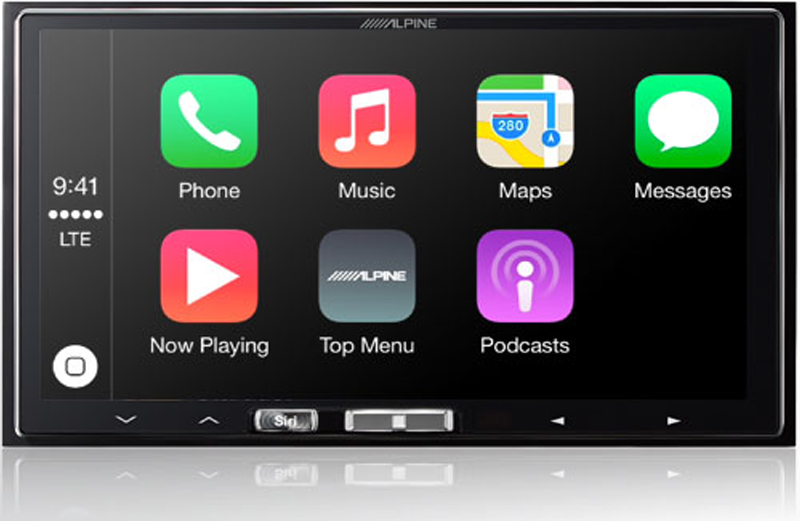 If you own an iPhone and are looking for the latest in CarPlay technology, then check out the new Alpine iLX-107. Introduced at the 2017 Consumer Electronics Show in Las Vegas, the iLX-107 is the first aftermarket source unit to feature wireless Apple CarPlay connectivity. Let’s take a closer look at what the iLX-107 can offer you.
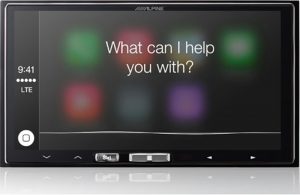 Up until now, using Apple CarPlay meant that you needed to connect a Lighting Cable to the bottom of your phone. This wired connection handles audio, video and data transfer between your iPhone and the source unit. Wireless CarPlay uses a WiFi connection to transmit data between the system and the phone. There is no longer a need to connect a cable. This feature is awesome if you are in-and-out of your vehicle several times a day. The system automatically reconnects without pressing any buttons.
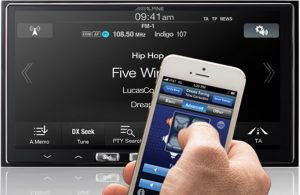 Information about your vehicle can be displayed right on the screen using an optional iDatalink Maestro RR vehicle interface. The iLX-107 also includes 2-volt front, rear and subwoofer preamp outputs to allow for system expansion. Crossovers, equalization and time alignment settings are adjustable using the Alpine TuneIt app on your cell phone. The iLX-107 is compatible with conventional steering wheel control interfaces and will accept a backup camera input.


